Image Source: New Balance
Introduction
I started working on this piece back in the Fall of 2025 but never got around to publishing it. The trouble I ran into was that since I started working on this piece (which is mostly critical of the SC Elite) New Balance went on a tear. Triathlete Alex Yee went and ran a 2:06 marathon in the SC Elite v5, the brand’s recent releases of the 1080 v15 and Ellipse seem quite popular, and they recently reported a nearly 19% increase in sales from 2024—clearly they’re doing a lot of things right. I started questioning whether I knew what I was talking about. While the brand is clearly trending upwards, I’m sitting behind my computer saying they’ve missed the mark with this release.
After abandoning this piece for a few months, I found solace in speaking with other runners about New Balance’s super shoes and realizing that the general consensus was that they’ve been a few years behind their competitors. While New Balance might be winning in many areas, this one historically hasn’t been their strongest.
After reading this piece over again, I realized that even if I missed the mark entirely, it was at the very least an interesting thought experiment to share. Additionally, while I may be critical of many of the choices New Balance made with this model, super shoes are only a fraction of their portfolio and hardly move the needle for the brand at large. I also don’t think this is a bad shoe by any means—I like it enough to use it in my own training rotation.
My goal with this analysis was to take a very zoomed in look at the current landscape of marathon racing shoes and examine how these changes affect where I would position the SC Elite v5 relative to where the v4 used to play. I look at which shoes each model was competing with, how New Balance might be ceding market share to competitors, and what this could mean for New Balance as a brand.
Methodology And Framework
I published an article recently titled Qualitative Observations On Super Shoe Purchase Behaviour. In that article, I explore the intuitive decision-making process behind how runners perceive and evaluate shoes in a retail setting. This analysis of the SC Elite applies these consideration factors to evaluate how the SC Elite’s market positioning has changed from the v4 to the v5 and explores why certain runners may or may not purchase these shoes as a result.
As I mentioned, I have never had the opportunity to sell the v5. I have, however, been using the v5 as a regular part of my own training rotation and worn and sold the v4 and every other competitor I plot these shoes against. Based on my experience wearing the v5, I have extrapolated its market positioning based on similar competitors and how I would position it to customers.
To visualize how competing models stack up against each other, I assessed each product along two dimensions that, in my experience are key in assessing which shoe is right for a customer:
Performance
This dimension looks at how suitable the shoe is for pinnacle road racing (ex. 2h30 marathon). Shoes that score higher here are typically lighter, stiffer, and more aggressive, and prioritize propulsion and efficiency over comfort and stability.
Accessibility
This dimension looks at how approachable the shoe is for recreational runners (ex. 4h+ marathon). Shoes that perform well in this dimension deliver a lot of the energy return that performance-forward shoes do, while offering more stability, more cushioning on the tongue and collar, and an overall sense of comfort that endures through the latter stages of a race.
I evaluated each product on both dimensions using a relative scale of 1-10 based on my own wear testing. Scoring low on performance, for example, does not mean that the shoe performs poorly per se, but rather that it is less suitable for pinnacle road racing compared to other models available.
While not a perfect science, this framework is designed to mirror many of my in-store consultations unfold: understanding the level of importance of each dimension to the runner and recommending a shoe that best satisfies that balance.
Throughout this analysis, I also look at two distinct customer segments and how their purchase behaviours might impact their perception of the shoes: competitive and recreational. This is not meant to define who is and isn’t a competitive runner, but their training and performance demands will naturally differ; someone running under 2h30 for a marathon will be looking for a shoe that prioritizes propulsion, whereas someone finishing in 4-hours will need to consider having more support in their shoes. There are also some relevant differences in purchasing behaviour and price sensitivity of both of these segments.
Competitive runners are generally less price sensitive and prioritize the feel and perceived performance benefits of the shoes they’re considering. When coming into a run specialty store, they also tend to rely less on sales associate input and lean more heavily on prior research and intuition. These customers prioritize the performance dimension in their shoes.
On the other hand, recreational runners are more price sensitive—I have found they have a resistance point around $300CAD. Shoes at or below this price point satisfy their core needs, whereas shoes above this price point are often perceived as overengineered for their purposes. This also aligns with the pricing strategies of shoes in this category, which I will comment more on later. While performance is still a consideration, these customers are willing to make a trade off for added support.
Competitive Analysis
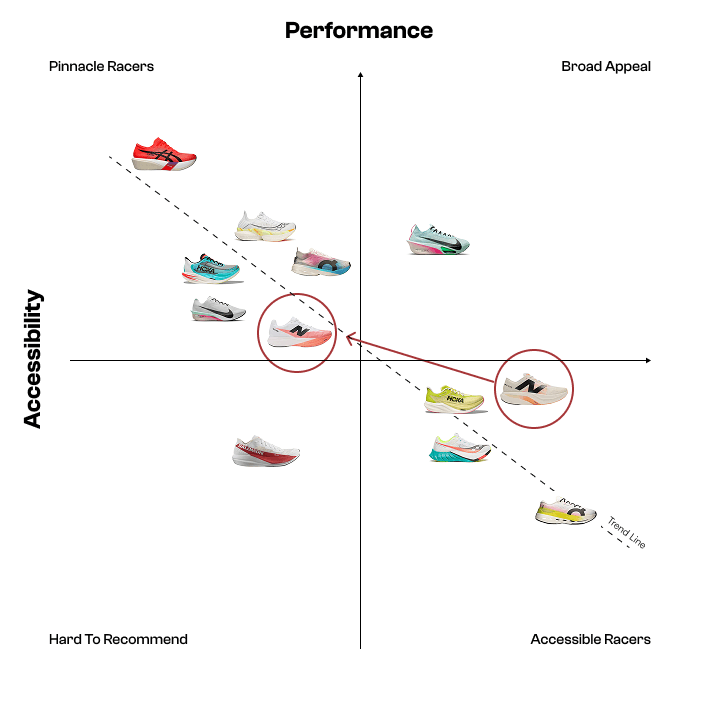
To visualize the positioning of the SC Elite relative to its competitors, I plotted each shoe on a positioning map with Accessibility on the x-axis and Performance on the y-axis—creating four quadrants:
Broad Appeal (High Accessibility, High Performance)
Accessible Racers (High Accessibility, Low Performance)
Hard-to-Recommend (Low Accessibility, Low Performance)
Pinnacle Racers (Low Accessibility, High Performance)
The trend line suggests that both dimensions generally have an inverse relationship, with most models clustered in quadrants #2 and #4 putting either performance or accessibility forward.
Where The SC Elite v4 Won
As shown in the positioning map, the v4 sat comfortably in the “Accessible Racers” category—strong in accessibility and among competitors in this category, high in performance—catering well to recreational runners needing more support in their racing shoes.
I can’t say for sure, but based on how this shoe was priced and what I’ve read about it from New Balance, the brand didn’t intend to play in this field. The v4 was meant to be their pinnacle offering, they simply missed the mark.
The winners, however, were the consumers shopping for a more accessible shoe. They got a shoe that was designed to be a pinnacle racer, but made accessible with its wide base, balanced rocker, and comfortable upper. Many customers I’ve fitted for this shoe described it as “feeling the most like a regular shoe [compared to competitors]”, a compliment that reflects how seamlessly it bridged the gap between their everyday trainers and a plated racing shoe.
This reflects its place on the positioning map: high in accessibility and high in performance relative to the shoes it's really competing against.
As I noted earlier, many runners shopping in this category have a resistance point of around $300CAD. So when the shoe was marked down preceding the v5’s release, it became an easy recommendation to customers in this segment.
Where The SC Elite v5 Competes Now
The v5 represents a clear shift in focus for New Balance. Compared to its predecessor, this iteration features a noticeably stiffer carbon plate, a narrower platform, and more aggressive geometry—justifying its place in the Pinnacle Racers category. As a result, it has parted ways with a lot of the features that made the v4 appealing, namely its stability.
In its new category, I struggled to find any features that truly differentiated the v5 against its competitors. This space is crowded with established competitors like the Vaporly, Metaspeed series, and Endorphin Elite—all of which offer what the v5 does and more. While the v5 checks the boxes for positioning itself in this category, it lacks differentiation. In such a saturated segment, simply being present isn’t enough.
An argument could be made that at $330CAD, the v5 undercuts some of its competitors on price. However as I mentioned earlier, runners shopping in this category are less price sensitive. For an extra $20, runners open the doors up to more unique-feeling products or brands that deliver a more impactful performance story.
These points raise a broader question about how competing brands in this segment are carving out unique positions despite operating within the same technical constraints.
Competitor Points Of Differentiation
As racing shoes have reached a performance parity, brands can no longer advertise having the “fastest” shoe like Nike was able to when they turned the industry upside down with the original Vaporfly. Any measurable increase in performance benefit from one brand to another will generally be negligible and outweighed by factors like feel and comfort. As such, brands need to find new ways to make their product stand out. I cover a couple of these topics a bit more in-depth in my article, Qualitative Observations On Super Shoe Purchase Behaviour, but I will restate them here in the context of the SC Elite v5.
Ride Identity
At some point in the last five years, nearly every major brand has released a racing shoe with a PEBA-based midsole and a carbon plate (or some variation of a plate) embedded in it. As this has become the industry standard for materials and every brand operates under the same technical constraints, such as the 40mm limit on stack height, some brands are making their products stand out by creating a unique ride identity through materials or construction.
The Saucony Endorphin Elite 2 is a great example of going the extra mile in materials. With this model, Saucony moved away from PEBA entirely and instead used a softer, more responsive TPEE-based foam. The result is far and above the softest racing shoe I’ve ever tried on, the closest comparison being strapping marshmallows to your feet.
By contrast, the HOKA Cielo X1 2.0 is a great example of how brands can achieve differentiation through design rather than materials. Despite also using a PEBA-based midsole, HOKA’s combination of an aggressive forward rocker and winged carbon plate delivers one of the most propulsive, yet stable rides I’ve experienced. Same materials as the SC Elite or the Vaporfly, totally unique feeling.
The uniqueness of both models makes it easy for me as a sales associate to recommend them to runners looking for the distinct ride they offer. While the v5 is on par with competitors, it introduces few meaningful innovations that distinguish it within the category.
Tiered Portfolio
Having a tiered portfolio of racing shoes (i.e., an accessible racer and a pinnacle racer) allows brands to extend their reach to runners at different performance levels. Having a shoe that’s competitive in the pinnacle category gives a brand credibility, while a more accessible counterpart reaches a larger consumer base. This strategy also creates a natural progression within a brand’s ecosystem. An accessible model bridges the gap between everyday trainers and plated racing shoes. As runners build trust with the brand and progress in their own running, they will be more likely to upgrade to a pinnacle shoe within the same brand.
On’s accessible racing shoe, the Cloudboom Max, is marketed as being “engineered for finishing times of around four hours or more” (On). This explicit segmentation makes the Max feel intentionally designed for the everyday runner, as opposed to being an underengineered version of the Cloudboom Strike. Other brands, including Saucony and HOKA, have implemented similar two-tier structures, pairing their pinnacle models with more accessible counterparts. Interestingly, all three brands have priced their accessible racers between $290 and $300CAD*, right at the resistance point I mentioned earlier.
With the v5 moving the SC Elite model from a more accessible shoe to a pinnacle shoe, New Balance has created a gap in their lineup between the SC Trainer and the SC Elite. According to New Balance, the Trainer is “built for half- and full-marathon training”, whereas the Elite is designed for racing. As I’ve already discussed, with less stability and more aggressive geometry, the v5 is not a great entry-level racing shoe. This jump from the Trainer to the Elite—both in price and performance—may be too large for some consumers, leading them to look at more accessible alternatives from competing brands. The absence of a clear progression in New Balance’s lineup not only limits New Balance’s reach in a high-volume segment, it also undermines the brand’s ability to guide runners through a continuous product journey.
*Since I first wrote this, Saucony released the updated Endorphin Pro 5 priced at $325
Brand Storytelling
With innovation reaching performance parity, a brand’s ability to build emotional or aspirational connections to its product becomes a powerful differentiating factor. Effective storytelling makes a product more memorable and allows a brand to justify its premium pricing.
It would be impossible to discuss storytelling without mentioning Nike. In my own wear testing, I wasn’t blown away by the Vaporfly 4. Once a leader in the pinnacle category, this iteration feels lackluster compared not only to competitors, but its own earlier iterations. Despite this, the shoe still sells. In talking with customers, much of that success can be attributed to Nike’s first-mover advantage and the story it’s associated with. Years later I still have customers coming in and asking about the “illegal shoes”.
The shoe’s midsole is embossed with “THE ORIGINAL SUPERSHOE”, a reminder of the shoe’s association with the Sub-2 project and that it's not only a competitor in the category, but the one that created it. This case study is a great example of how a strong story can sustain a product’s credibility even after its technical edge has faded.
The SC Elite doesn’t have a clear differentiating narrative to set it apart from competitors in the pinnacle category. If anything, this lack of identity creates a disconnect between the product and New Balance’s broader messaging.
In 2023, the brand launched its Run Your Way campaign through which, according to Sports Illustrated, New Balance hopes to promote an inclusive, positive, and uplifting running environment for all – no matter how you run”. With the v5’s narrower focus on performance, the shoe feels at odds with New Balance’s inclusive identity, excluding and potentially alienating many of the runners it welcomes.
What This Means For New Balance
Here is a summary of the impacts the changes in the SC Elite v5 could have.
Lack Of Differentiation In Pinnacle Segment
By pushing the SC Elite deeper into the pinnacle racer category, New Balance is now up against more established competitors in this space. Without a clear and unique advantage to the v5, New Balance risks being present but invisible in this category.
Loss Of Share In Accessible Racer Category
The SC Elite v4 was a great option for runners looking for an approachable racing shoe. By moving away from that space, New Balance forfeits a profitable and growing consumer segment. This shift will likely give away market share to the HOKA Rocket X, Saucony Endorphin Pro, and On Cloudboom Max.
Weakened Sales Floor Storytelling
The v4 was easy to pitch to customers needing an accessible racing shoe. The v5’s differentiating factors/value proposition are less obvious, making it challenging for staff to connect it to customer pain points quickly. When a product isn’t clearly differentiated, it limits retail associates’ ability to advocate for it.
Mixed Brand Messaging
The v5’s narrower focus on pinnacle performance clashes with New Balance’s inclusive identity, excluding and potentially alienating many of the runners its marketing welcomes.
Missed Portfolio Synergy
Competitors like Saucony, HOKA, and On have clear two-tier systems that guide customers upward. Without an accessible counterpart to the SC Elite, New Balance lacks a natural progression from the SC Trainer to the SC Elite, weakening customer lifetime value.
Looking Ahead
With all this said, what can New Balance do to effectively position the v5?
For one, I think New Balance can do a better job at communicating the v5’s differences compared to competitors. The tech sheet we were given at the running store I worked at only reinforced that the shoe lacked differentiation. From this sheet, the only differentiating factor that I would bring up in a shoe fitting is that it’s designed to create a natural feeling transition from training shoe to race shoe.
Other factors mentioned, like the shoe being “geared towards runners striving to run their fastest time over a marathon” or how lightweight the shoe is are not differentiating at all. Every carbon plated racing shoe is designed to help you run your fastest (what would be the point otherwise?) and lightweight isn’t a differentiating factor unless your shoe is the lightest.
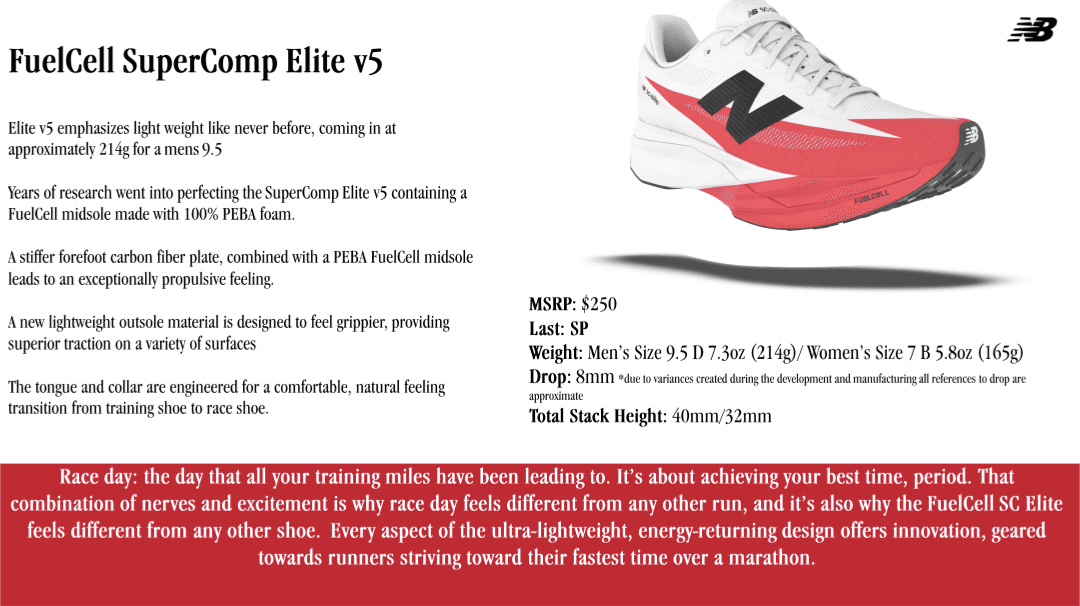
Another step would be to build a story around the shoe. Alex Yee’s 2:06 gave the shoe some street cred, it’s now up to New Balance to keep that momentum going and make sure the v5 is positioned as a truly elite competitor in this space. Taking a shoe from “We have a racing shoe!” to a shoe that people feel inspired to buy is of course no easy task.
Finally, and perhaps this is a bit of a reach, but adding a more accessible “flanker” racing shoe would improve New Balance’s portfolio synergy and improve the SC Elite’s perceived value as competitors like Saucony, HOKA, and On are already doing with their two-tier systems.